
科目组合
英语一: 英语知识运用 、阅读理解 、写作
答题情况分析报告
Part B
Directions:
In the following text, some segments have been removed. For Questions 41–45, choose the most suitable one from the list A–G to fit into each of the numbered blanks. There are two extra choices, which do not fit in any of the blanks. Mark your answers on the ANSWER SHEET. (10 points)
[A] And just read a single poem. In his Oxford lectures, Seamus Heaney argued that a poem draws a picture of reality, a “glimpsed alternative” that sets up a contradiction with your own, in ways little and large. The negotiation, between you and it, is the heart of the matter. What does the poet see that you don’t? What does the difference mean? It could be one of the best conversations you ever have. Forget self-help books; reading is self-help in action.
[B] But for the most part, this isn’t what the business community does. I have yet to meet a chief executive who reads regularly. Many skip newspapers, and magazines are a stretch. They don’t have time, they say. It’s inefficient; they can get the information they need from those around them. At a pinch, they might pick up a business book before a long flight, in the hope that, like a cookbook, it will provide a foolproof recipe. Some are drawn to what I think of as “business car crash” books-the stories of Theranos, Purdue, or WeWork. But outside those narrow pools of interest, a vast ocean awaits, bountiful with simmering ideas, mental adventure and imaginative refreshment.
[C] Neuroscientists have been at pains to demonstrate that the pleasure a book provides isn’t indulgence; it’s good for you. Reading will keep you better informed about the world but it can also improve our tech-shattered ability to concentrate. Standing in the shoes of others fine tunes our social understanding, useful as we struggle to understand friends, neighbours, customers and co-workers. Differentparts of our brain engage as we simulate scenes, characters and mental states. Our imagination-remember that? -is rekindled.
[D] It is undoubtedly true that all work and no play really does make Jack, or Jill, dull. The cure is right at hand, reading is cheap, easy and, most important, it’s fun. Liberate your imagination this year.
[E] We are living through a golden age of science writing. So lucid and accessible that even lay readers can relish the unpredictability of discovery. Daunted by uncertainty? Stand in the shoes of scientists and witness the degree to which breakthroughs emerge from accidents, conflict and sheer mental stamina. “We are never sure of anything,” says the physicist (and writer) Carlo Rovelli.
[F] You don’t need to get out more. If, like most business people, you spend your life dashing from office to plane, train to home, boardroom to washroom, what you really need to do is stay in more. Sit down-and read a book.
[G] Reading has also been found to make us more helpful, to reduce bias, and even to increase longevity-something we will enjoy all the more if we have a good book in our hands. (And yes, all these benefits are more closely associated with physical books than digital ones. )
[H] Read fiction. Any fiction. Free yourself from algorithms and choose-anything you don’t need technology for an immersive experience just surrender to narratives across time and place. Modern (Sebastian Barry or Olga To karczuk), classic (Virginia Woolfor James Baldwin) or genre (Stephen King, Margaret Atwood, Georges Simenon)-it doesn’t matter. Fiction invites you to loiter the unseen. Inthe lives of others. We are living through a golden age of translation too, so you can go anywhere in time or place.

(F→41→42→H→43→C→44→45,请将41-45题的答案填入下方的输入框,不区分大小写)
BEDGA
评分及理由
(1)得分及理由(满分2分)
学生答案:B。与标准答案41题一致。该选项承接首段[F](建议商务人士多读书)的转折,指出商业界人士普遍不读书的现象,逻辑衔接顺畅。得2分。
(2)得分及理由(满分2分)
学生答案:E。与标准答案42题一致。该选项以“We are living through a golden age of science writing”开头,与前文[B]段末尾“a vast ocean awaits... mental adventure”形成内容上的扩展,从商业书籍转向更广阔的阅读领域(科学写作),衔接合理。得2分。
(3)得分及理由(满分2分)
学生答案:D。学生将此选项放在43题位置,但标准答案43题为A。此处逻辑衔接出现错误。在给定结构(...H→43→C...)中,[H]段建议读小说,[C]段从神经科学角度阐述阅读的好处。学生填入的[D]段(“It is undoubtedly true that all work and no play... The cure is right at hand, reading is cheap, easy...”)更像是一个总结性或呼吁性的段落,放在此处与前后文(特别是后接的[C]段)的论证逻辑不连贯。[C]段是具体的科学论证,前面接[D]段的总结显得突兀。因此,此空答案错误。得0分。
(4)得分及理由(满分2分)
学生答案:G。学生将此选项放在44题位置,与标准答案44题一致。在结构(C→44→45)中,[C]段讲阅读的神经科学益处,[G]段以“Reading has also been found to...”开头,列举更多益处(更有帮助、减少偏见、延长寿命),是典型的并列补充关系,衔接紧密。得2分。
(5)得分及理由(满分2分)
学生答案:A。学生将此选项放在45题位置,但标准答案45题为D。在结构(44→45)中,[G]段后接[D]段作为全文的总结和呼吁是合理的。学生填入的[A]段(“And just read a single poem...”)是具体建议读诗,并展开讨论诗歌的价值,这与前文[G]段对阅读益处的总结性列举在逻辑层次上不匹配,且作为文章结尾显得力度不足,未能很好地总结全文。因此,此空答案错误。得0分。
题目总分:2+2+0+2+0=6分
Part B
52. Directions:
Write an essay of based on the charts below. In your essay you should
1) describe the drawing briefly,
2) interpret the charts, and
3) give your comments.
Write your answers in 160 - 200 words on the ANSWER SHEET. (20 points)
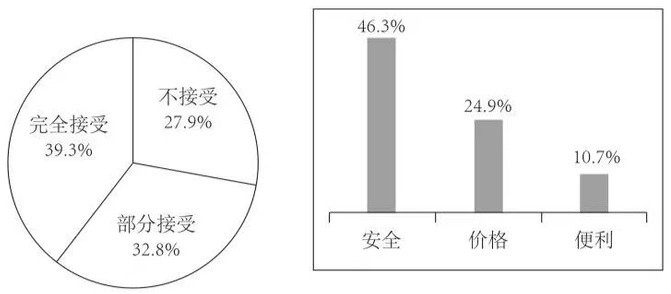
(图表数据:饼图(对应 “接受程度” 类数据):完全接受:39.3%,部分接受:32.8%,不接受:27.9%;柱状图(对应 “相关因素占比” 类数据):安全:46.3%,价格:24.9%,便利:10.7%)

 The road of your choice, you have to go on !
粤ICP备16082171号-1
The road of your choice, you have to go on !
粤ICP备16082171号-1


